ThingThingThing
2021
2017–2021
A shared world of programmed entities
ThingThingThing is a computational environment that facilitates the creation and interaction of digital entities. Developed through collaborative workshops and/or online participation, it allows participants to define entities within certain parameters. Once introduced into the system, these entities exist and interact autonomously, evolving without further direct human intervention.
The visual design of ThingThingThing is characterized by its abstract, geometric aesthetic. The creatures and the environment they inhabit are intentionally non-realistic, as the project focuses on examining and experimenting with paradigmatic computational systems.
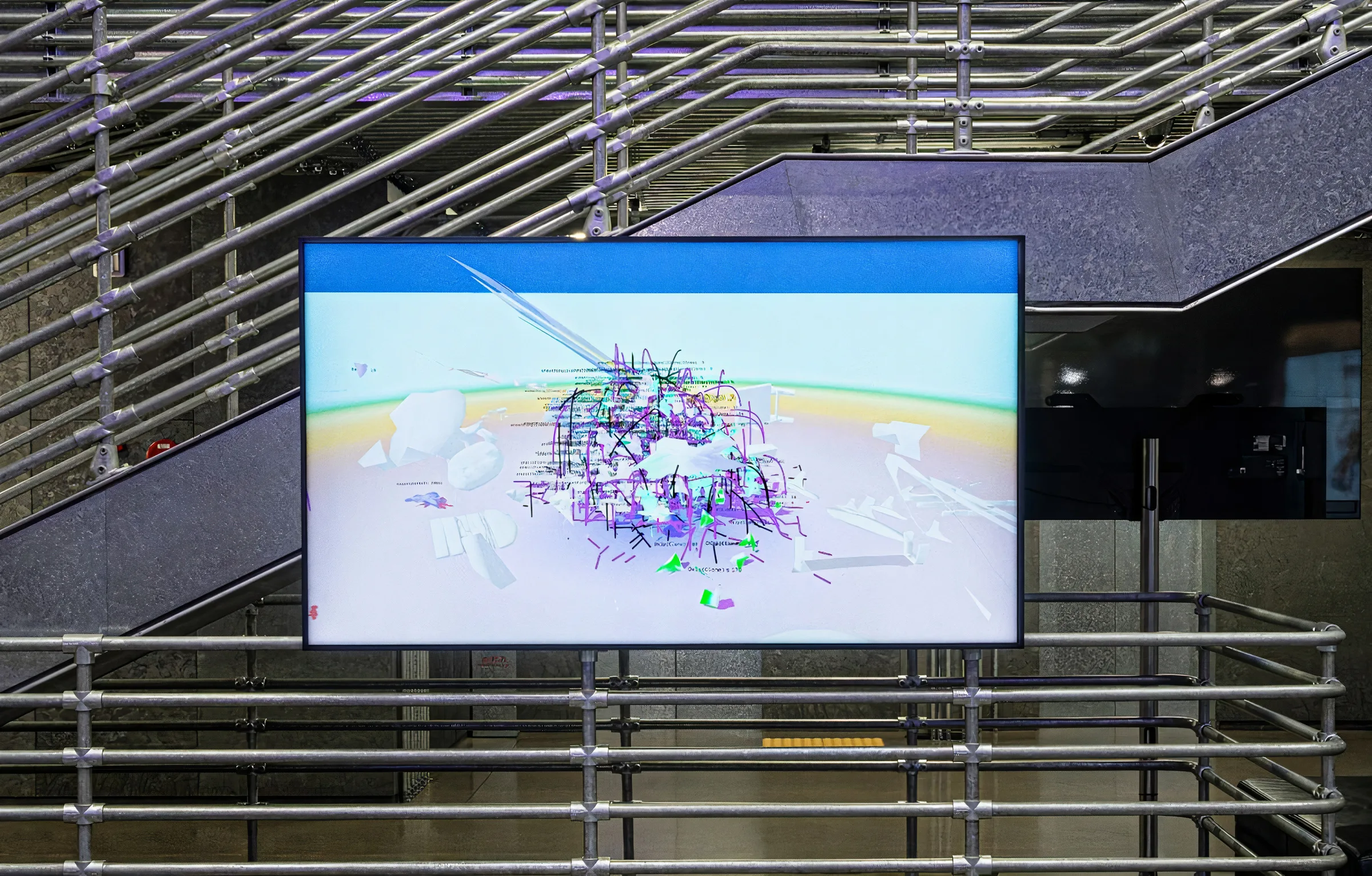
Exhibition view: World on a Wire, South Korea. Presented by Hyundai Artlab and curated by Rhizome.
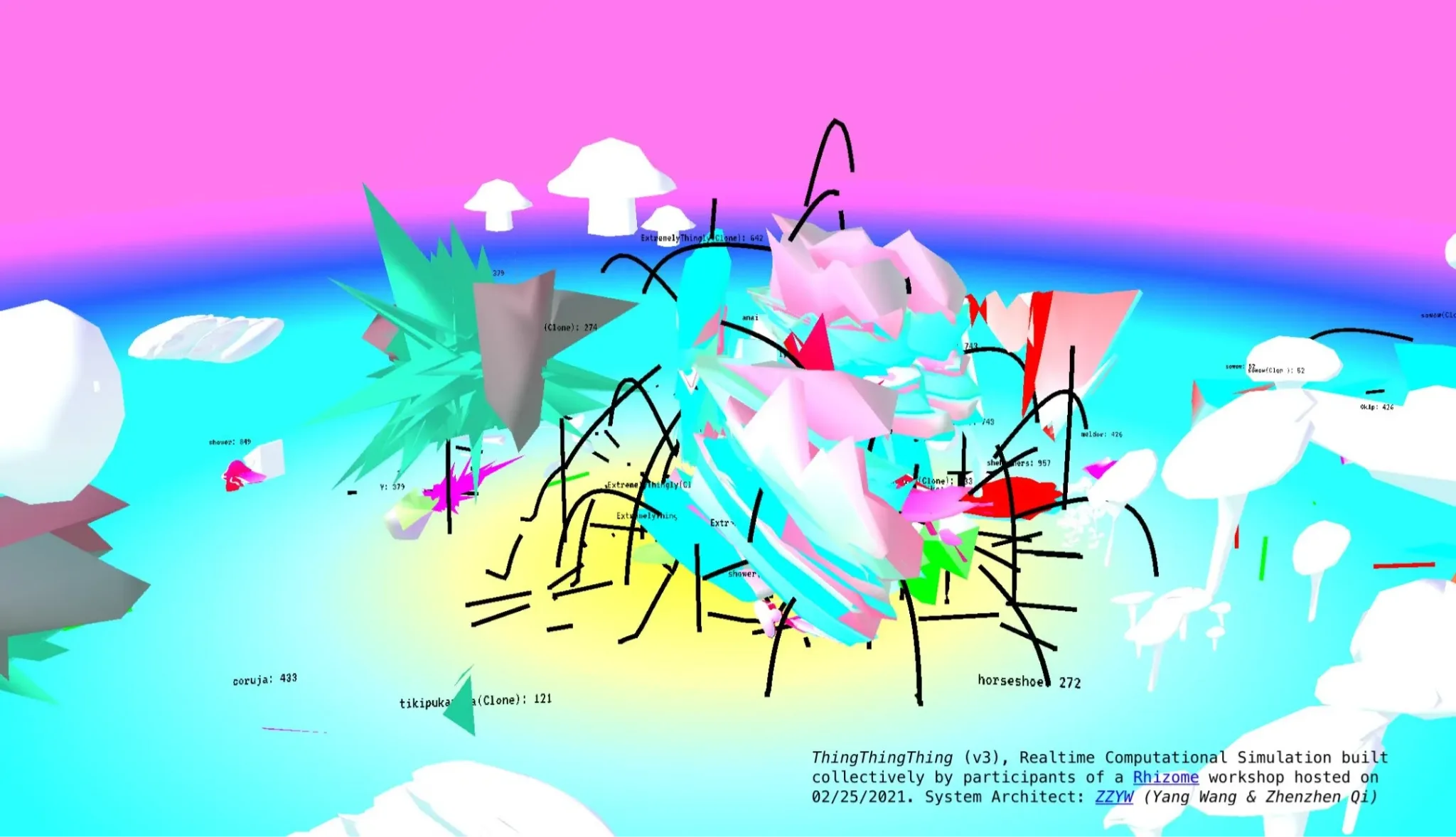
The caption is included in the image.
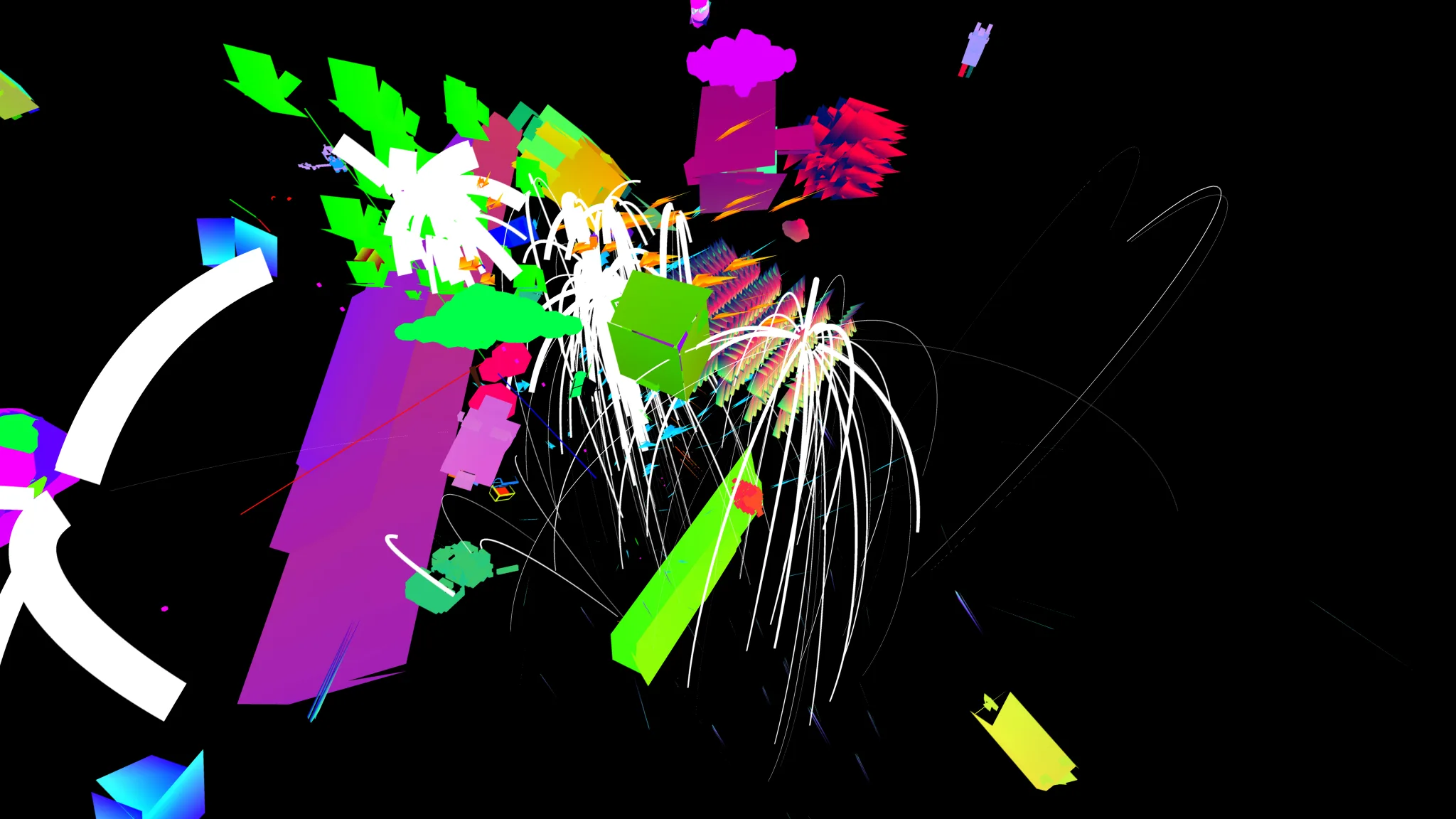
An earlier version, shown in “Bad Code” at the Power Station of Art, Shanghai, in 2017.
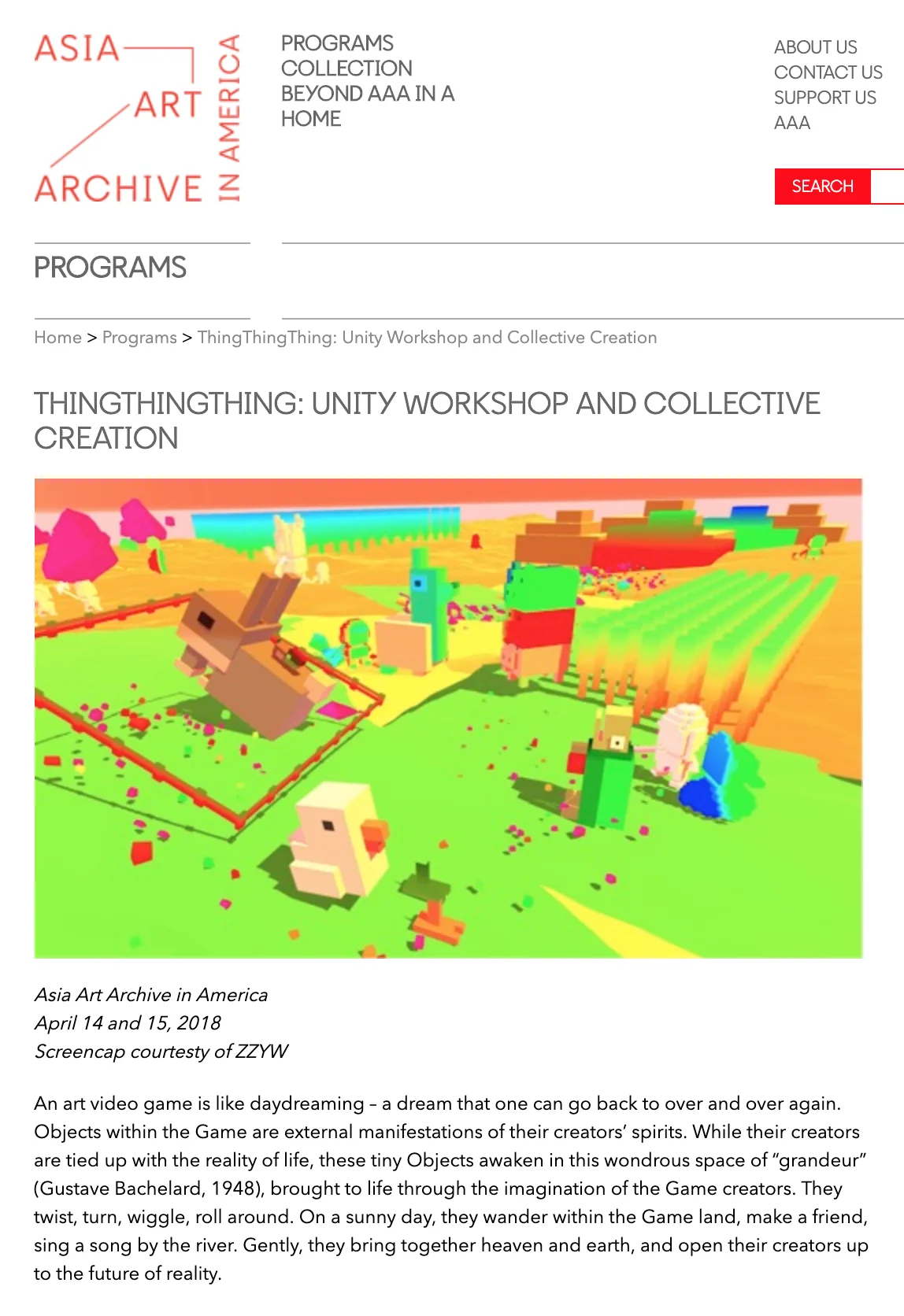
Video documentation:
https://drive.google.com/open?id=17Zd1zm0kk-5ie5lvVmxv0AiCQRm77-eN&usp=drive_fs
https://drive.google.com/open?id=10ylchLGDI4tLBxpo4yXNv9jRBG9tUeog&usp=drive_fs
Version created by members of NEW INC, 2020.
Two different versions.
Authoring rules and negotiating their consequences
ThingThingThing examines a relation to computational objects in which making an object and directing its actions are separated. Participants write the rules through which a Thing responds to its surroundings. Once released into the simulation, it continues to act without their continuous instruction. Participation moves between specifying the conditions of an object’s behavior and observing what happens when those conditions meet a world shared with others.
Writing these rules brings the participant into contact with the object’s operation. Making involves working with the conditions and actions that constitute a Thing; they have to focus on ‘how to’ as opposed to ‘what to do’. This creates a degree of familiarity with how the object works. Yet knowing its rules does not make everything it will do foreseeable. Its activity also depends on encounters with objects whose rules were written by other people, within a framework that defines the available forms of interaction.
The relation combines intimacy with distance. The maker has access to an object’s construction while its subsequent activity exceeds their individual intentions. This is also a condition of our everyday relations with software: we participate in systems whose operations continue beyond our immediate attention and whose behavior depends on processes we only partly understand. ThingThingThing approaches this condition through the experience of composing rules and then living with their consequences in a shared simulation.
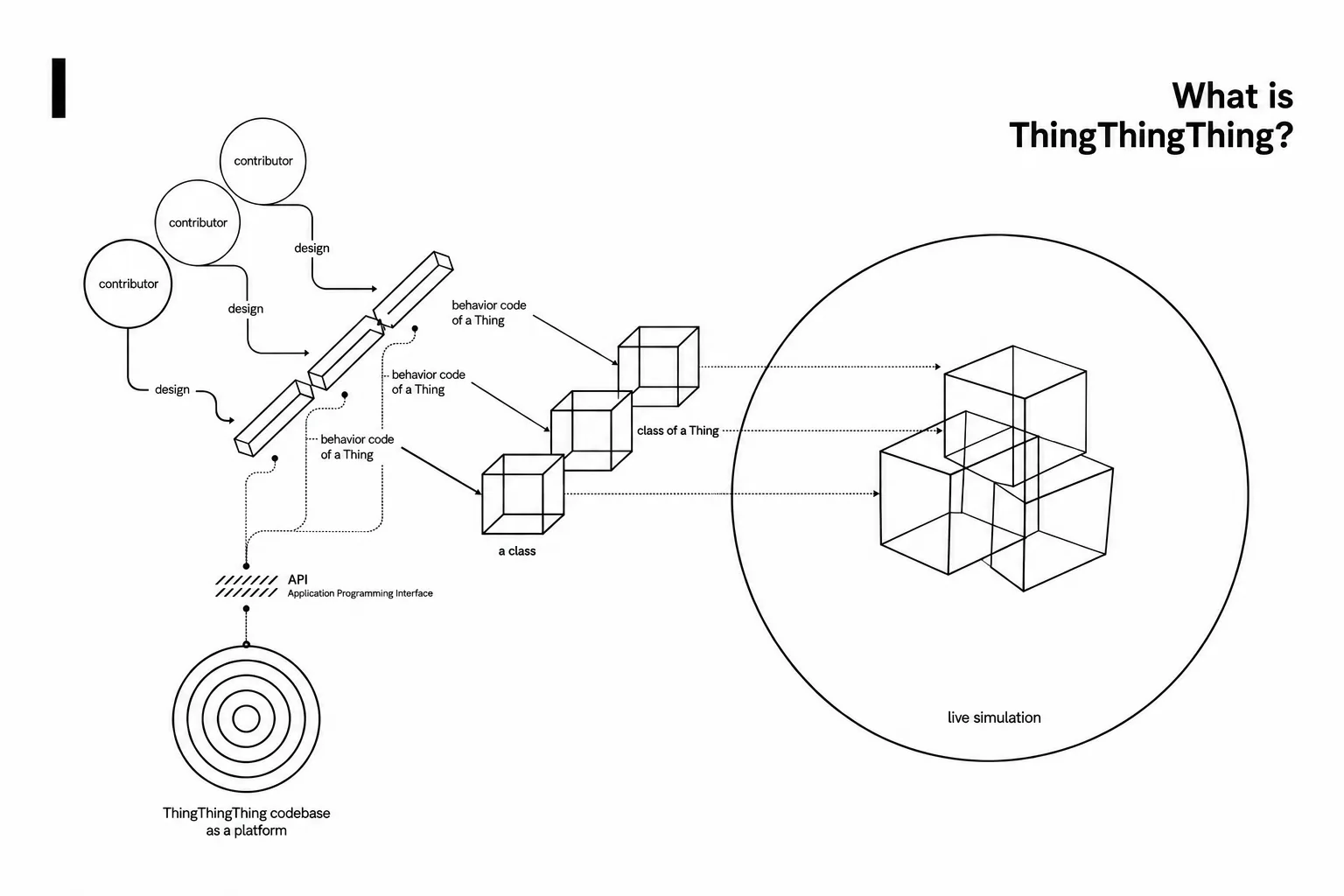
The capacity to negotiate with other contributors is constitutive of the ensemble. Each contribution helps establish the conditions in which other Things act, so decisions about one’s own object also concern what remains possible for someone else’s. Collective making requires contributors to attend to these consequences and negotiate how their intentions can coexist. Agency is exercised both in authoring a contribution and in sustaining the conditions under which others can contribute and act.
The image of “black pipes” emphasizes that computational opacity belongs to an ongoing activity. Processes continue to run and pass their effects onward even when their workings are only partially visible. A pipeline keeps running while we are trying to understand it; the effects of one operation enter into the conditions of another. Agency in this setting has to be sustained over time, through observing how contributions affect one another and negotiating where and how to intervene. Understanding a computational object involves attending to these continuing relations, including the actions of other contributors whose intentions are only partly expressed in the code.
From rule editor to shared simulation
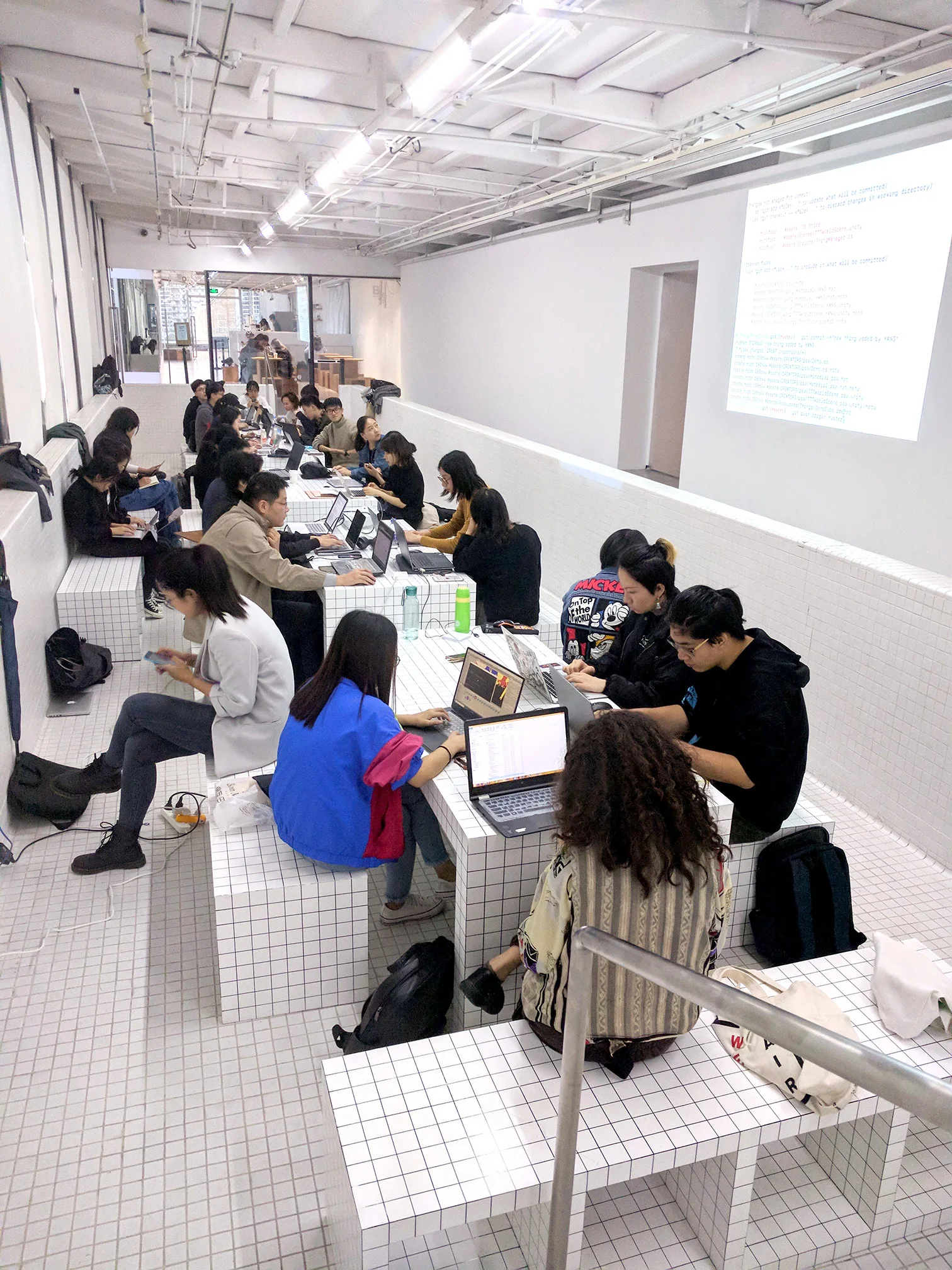
ThingThingThing uses Unity, a video game engine, as its front end and GitHub, a code-hosting platform, as its back end. The platform incorporates a web-based code editor, enabling users to establish rules for interactions among the entities. Whenever ThingThingThing is showcased, we collaborate with the exhibiting institution to organize a public collaborative world-building workshop, effectively bringing the artwork to life. During these workshops, we provide demonstrations of the interface and offer guidance to participants in crafting rule-based entities. At the workshop’s end, a unique simulation with its own narrative is created and made available online.
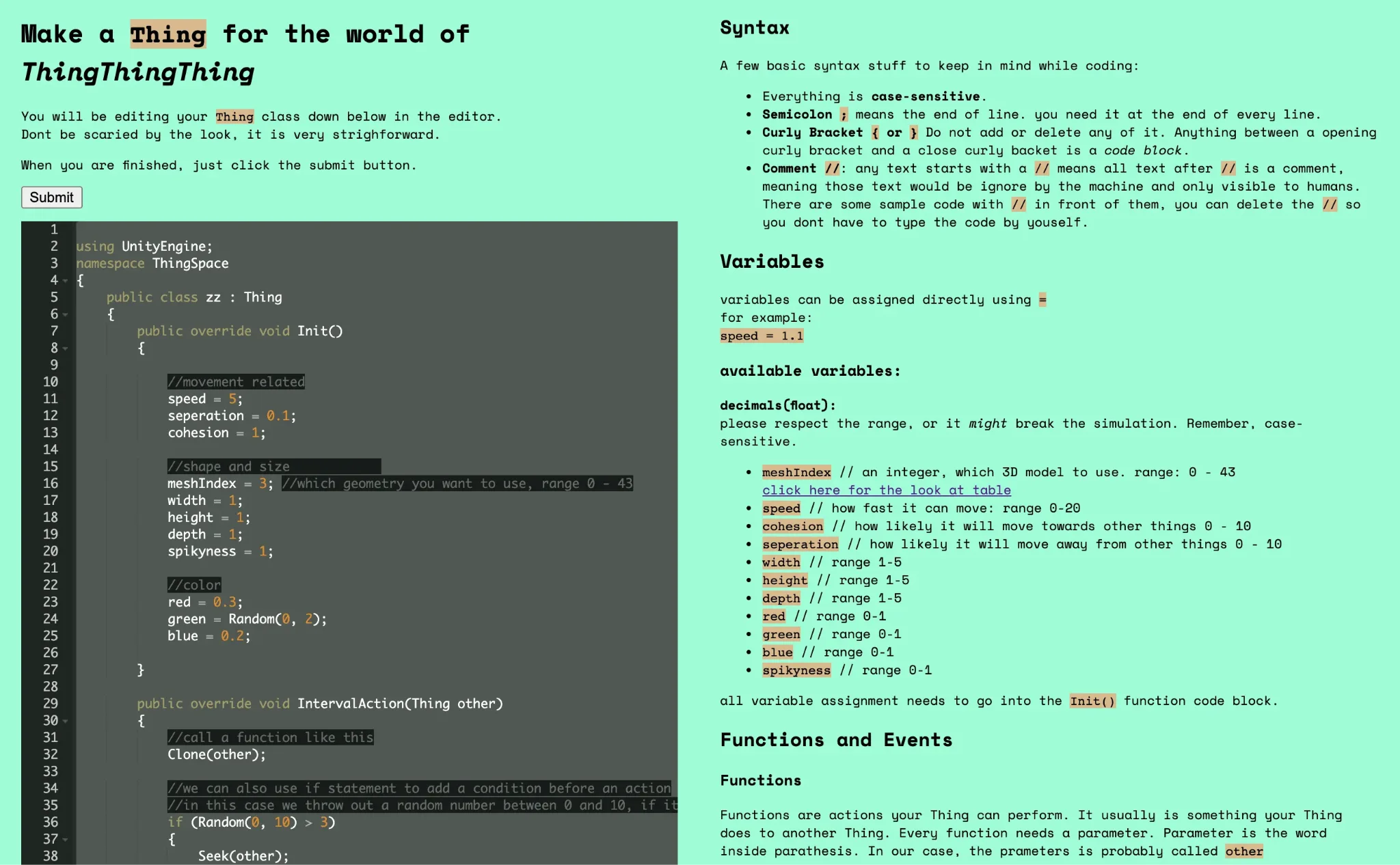
Note: The page is no longer active.
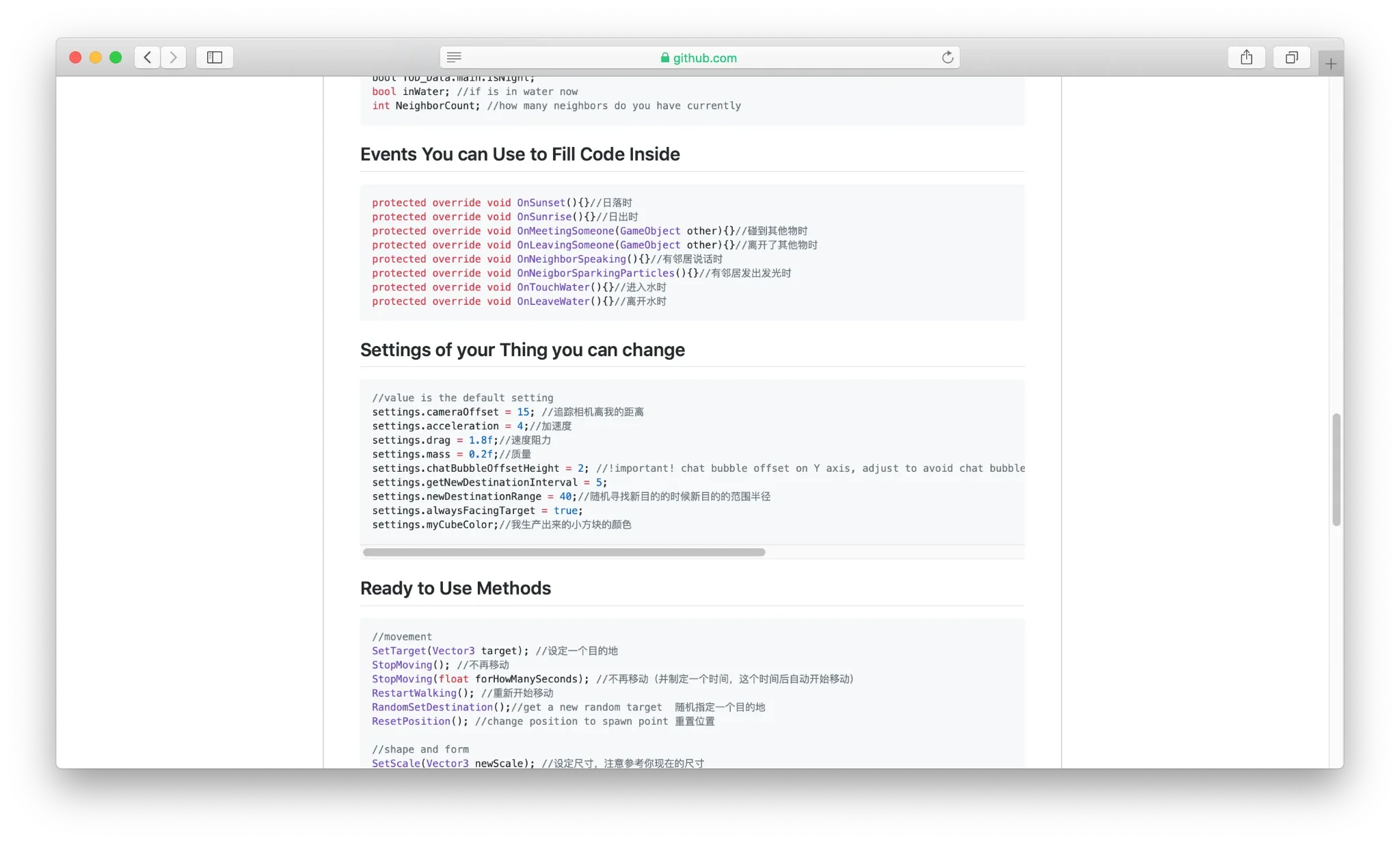
Note: The repository is archived.
Workshops and institutional collaborations
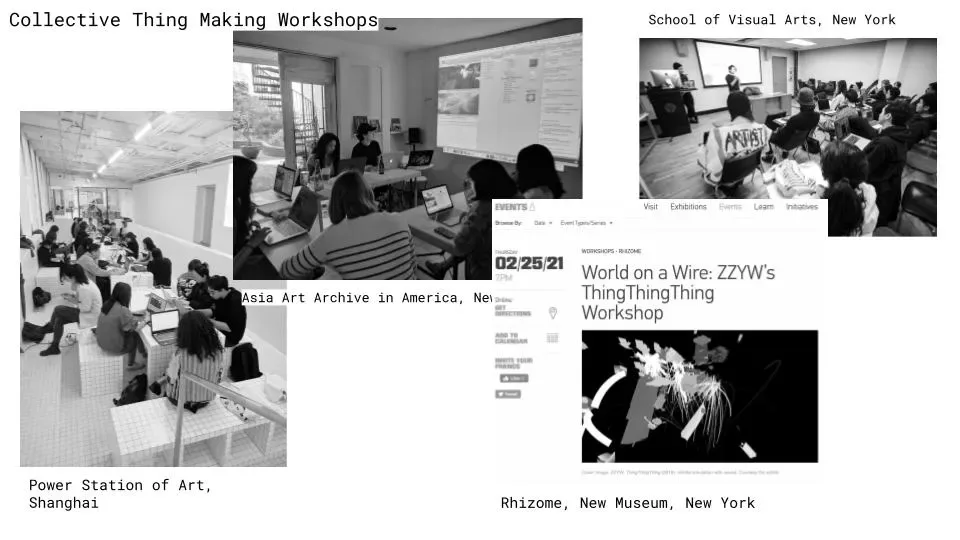
We have been hosting a series of workshops with museums and art institutions around the world. These workshops enable students, artists, designers, architects, and technologists to create their own programmed creatures with intelligence. Past collaborators include:
- http://worldonawire.net/, curated by Rhizome of the New Museum
- NEW INC, New Museum, New York, NY
- Power Station of Art, Shanghai, China
- Macy Art Gallery, Teachers College, Columbia University, New York, NY
- City University of New York (CUNY), New York, NY
- Guangzhou Academy of Art (GAFA), Guangzhou, China
- Creative Tech Week (CTW), New York, NY
- Asia Art Archive in America (AAA-A), Brooklyn, NY
Exhibition History
- 2024 数知妙悟 & 四川美术学院实验艺术学院, Chongqing, China
- 2023 Tokyo University of the Arts, Tokyo, Japan
- 2021 Museum of Art Pudong, Shanghai, China
- 2021 Rhizome of New Museum @ https://worldonawire.net/, Online
- 2019 National Museum of China 中国国家博物馆, Beijing, China
- 2018 Power Station of Art 上海当代艺术博物馆, Shanghai, China
- 2018 Macy Art Gallery, Teachers College, Columbia University, New York, NY, US
Talks, essays, and interviews
- Software as Worlding Infrastructure — Yang Wang, 2025. Lecture manuscript from talks at Duke Kunshan University and Hong Kong Baptist University, on software as a medium that shapes what can be perceived and acted upon.
- What Is a Computational Object? — Guest talk, School of Visual Arts, 2020. Talk summary and documentation introducing computational objects through ThingThingThing and its programmable interactions.
- Architecting Emergence — Zhenzhen Qi, Rhizome, February 2021. Essay on systems, emergence, and collaborative worlding in the museum. The linked publication page leads to the Rhizome article.
- Between Code and Mystery — Zhenzhen Qi, ESP Culture Magazine, April 2021. Essay situating ThingThingThing within a discussion of computational systems, partial perspectives, and collective worldmaking.
- 漆贞贞、汪洋|揭开虚拟世界的地脉 — Interview by Wu Peiyue (吴佩悦), The Paper / 澎湃号, September 30, 2021, in Chinese. Discusses the project’s development, participants’ programmed behaviors, and the relation between visible images and the rules behind them.
- Out of Sight / 目所不见 — zzyw, 2022. Video essay in English and Mandarin, using desktop cinema to examine rulemaking and the development of ThingThingThing. The project page includes a viewing link.
All textual and visual materials on this website may be cited, referenced, or reproduced for scholarly, educational, or personal non-commercial use with appropriate attribution. Scraping, harvesting, or extraction of content for any purpose requires explicit prior authorization. Unauthorized scraping, particularly for commercial purposes—including the training of machine learning models—is strictly prohibited.
© Yang Wang, Zhenzhen Qi 2023 | All Rights Reserved